Überbevölkerung – neue Prognosen
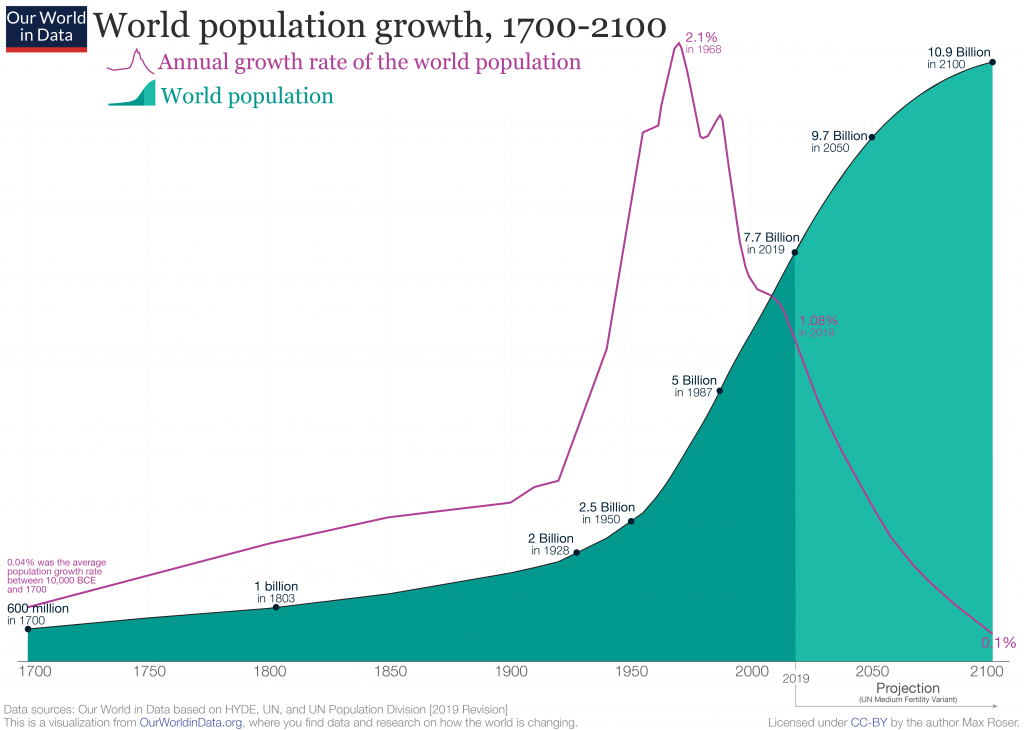
Die Bevölkerung wächst weniger schnell als erwartet. Die höchste Wachstumsrate gab es 1963 mit 2,3 Prozent – 2023 lag sie nur noch bei 0,9 Prozent, also bei weniger als der Hälfte (Quelle) – was immer noch viel ist. Fest steht aber: es gibt keine Bevölkerungsexplosion. Aktuelle Studien gehen davon aus, dass das Bevölkerungswachstum einen Gipfelpunkt erreichen und dann zurückgehen wird. Die Population Division der UNO geht von 10,9 Milliarden Menschen im Jahr 2100 aus, Jorgen Randers, ein Mitautor der Studie „Die Grenzen des Wachstums“ (Club of Rome) wird in dem Buch „Empty Planet“ mit folgender Aussage zitiert: „Die Weltbevölkerung wird 9 Milliarden Menschen nie erreichen. Sie wird ihren Gipfelpunkt von 8 Milliarden im Jahr 2040 erreichen und dann zurückgehen. (Quelle: Der Spiegel – „Die Menschheit wird schrumpfen“ vom 17.5.2019)
Auf der Seite „Our World in Data“ kannst Du Dir einen detaillierten Überblick über Bevölkerungsdichte und Wachstum verschaffen. Die Seite, von der auch die folgenden Grafiken stammen, enthält eine Fülle von vertiefenden Informationen über die Bevölkerungsentwicklung.
Weltbevölkerung 2018

Bevölkerungsdichte

Bevölkerung pro Land


Bevölkerungsentwicklung je Kontinent


When will the world population stop growing?
How do we know that population growth is coming to an end? The world is reaching peak child
Following decades of very fast population growth, there is often concern that population growth is out-of-control: that an end to growth is not in sight.
But we know this is not true: population growth is slowing and will come to an end. How do we know?
The world is approaching ‚peak child‘, the moment in demographic history when the number of children in the world stops increasing. This is pre-emptive of the moment in history when the population stops increasing.
The world is approaching what the late Hans Rosling called “the age of peak child”. The solid purple line in the visualisation indicates the total population of people under the age of 5, and the dotted purple line shows projections for this age group through 2100. As we can see, we are not far away from the largest cohort of children that there will likely ever be. The gray lines show the total world population – we expect an end to population growth as the number of children in the world begins to decrease.
This is an extraordinary moment in global history. In the past only two children per woman reached adulthood – if more had survived the population size would have not been stable. This also means that the extended family with many children, that we often associate with the past, was only a reality for glimpse in time. Only the few generations during the population boom lived in families with many children – before and after two children are the norm. The future will resemble our past, except that the children are not dying, but are never born in the first place.
Between 1950 and today it was mostly a widening of the entire pyramid that was responsible for the increase of the world population. What is responsible for the increase of the world population from now on is not a widening of the base, but a fill up of the population above the base. Not children will be added to the world population, but people in working age and old age.At a country level “peak child” is followed by a time in which the country benefits from a “demographic dividend”. The demographic structure of a country is reshaped so that the proportion of people in working age rises and that of the dependent young generation falls. The demographic dividend can result in a rise of productive contributions and a growing economy.4 Now there is reason to expect that the world as a whole benefits from a „demographic dividend“.
The big demographic transition that the world entered more than a century ago is coming to an end: Global population growth peaked half a century ago, the number of babies is reaching its peak, and the age profile of the women in the world is changing so that ‘population momentum’ is slowly losing its momentum. This is not to say that feeding and supporting a still rising world population will be easy, but we are certainly on the way to a new balance where it’s not high mortality keeping population growth in check, but low fertility rates.
Quelle: https://ourworldindata.org/population-growth

Was bedeutet das Wissen um ein absehbares Ende des Bevölkerungswachstums?
Es gibt keinen Grund (mehr) für Fatalismus nach dem Motto: „Es ist ohnehin egal, was wir tun, die Erde wird am Bevölkerungswachstum ersticken“. Das ist nicht richtig. Gleichzeitig gilt: Ressourcenverbrauch, ökologischer Impact und die Logik des Wirtschaftens muss letztlich einer Weltbevölkerung von bis zu 10 Milliarden Menschen angepasst sein. Es ist offensichtlich, dass der heutige Lebensstil der reicheren Länder und Bevölkerungsschichten unvereinbar ist mit der Tatsache, dass die Weltbevölkerung noch mindestens 50 – 80 Jahre wachsen wird.
Diskussion: SZ 7.8.19 – Nachhaltige Familienplanung: Keine Kinder fürs Klima? Das Problem ist nicht die Zahl der Menschen, sondern wie die Menschen ihr Leben führen. “ … eine groß angelegte Untersuchung der amerikanischen National Academy of Sciences aus dem gleichen Jahr (hat) ergeben, dass die Reduzierung der Bevölkerung eine Illusion ist. Die Studie untersuchte verschiedene Szenarien für das Bevölkerungswachstum und stellte fest, dass selbst eine weltweite Durchsetzung einer Ein-Kind-Politik zusammen mit ‚katastrophalen Sterbe-Vorfällen“ die Weltbevölkerung bis 2100 nicht wesentlich reduzieren würde. Stattdessen schlägt die Studie vor, dass „unmittelbarere Ergebnisse für die Nachhaltigkeit aus gesetzlichen Vorgaben und Technologien hervorgehen, die den steigenden Verbrauch natürlicher Ressourcen umkehren‘.„
Was sind wirksame Maßnahmen zur Senkung des Bevölkerungswachstums?
Bildung – insbesondere für Frauen
Verbesserung der Gesundheitsversorgung
Urbanisierung
Zugang von Frauen zum Arbeitsmarkt
Weitere Infos: Der Spiegel „Satte 10 Milliarden“
Nicht zu viele Kinder, sondern zu wenig Wahlfreiheit: der UN-Weltbevölkerungsbericht 2025
Der UN-Bevölkerungsfonds UNFPA hat für seinen Bericht 2025 mit YouGov Menschen in 14 Ländern befragt. Titel: „Die echte Fruchtbarkeitskrise“. Die Botschaft: Das Problem ist nicht, dass Menschen zu viele oder zu wenige Kinder wollen. Das Problem ist, dass viele nicht frei entscheiden können.
Fast jeder fünfte Erwachsene im fortpflanzungsfähigen Alter glaubt, nicht so viele Kinder haben zu können, wie er/sie möchte. 39 Prozent nennen Geldsorgen als Grund. Fast jede/r Fünfte nennt Angst vor der Zukunft – vor Klimawandel, Umweltzerstörung, Kriegen und Pandemien. Fast jede/r Dritte hat schon eine ungewollte Schwangerschaft erlebt.
Quellen: UNFPA: State of World Population 2025 – The real fertility crisis · UNFPA: State of World Population 2025